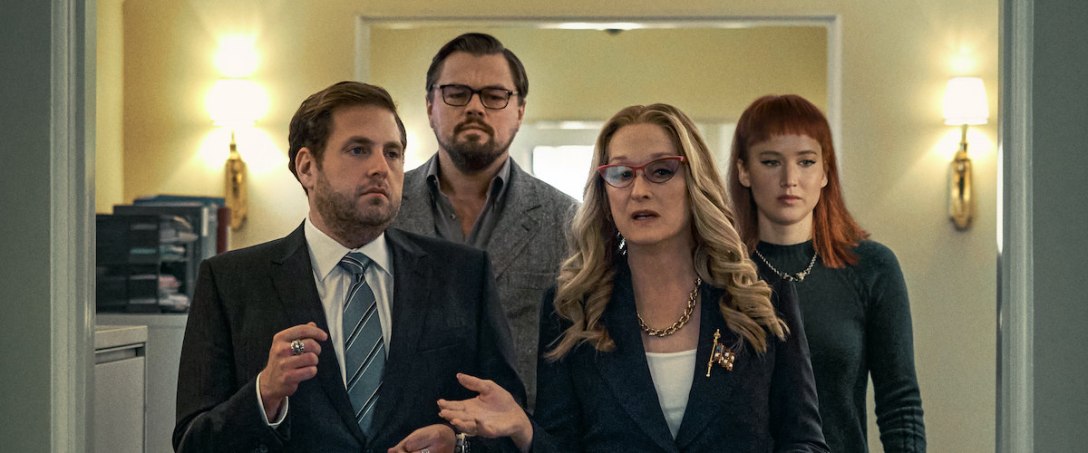
It is most fitting that in 2021 a film that concerns itself with the end of the world has been given to us. At this point we all have seen the worst of it, right? Our climate now is the subject of great and fastidious conversation, social media has permeated every corner of our lives and we’ve been steeped in bad news at every turn. And despite all that, Adam McKay’s newest, Don’t Look Up is filled with such insufferable self-importance, it becomes evidenced that McKay’s wit and edge has been dulled by the same smugness he so self-righteously denounces.
It seems an all too easy a manoeuvre to operate from the moral high ground, taking relentless jabs at the senseless media, morally corrupt, self-dealing government and billionaire-led, tech conglomerates. While nothing is inherently malignant about the core workings of the film, it is executed with such a tempestuous inaccuracy that all too often patronize and berate the viewer, without ever commenting on the issues at hand. It is neither funny nor charming.
In line with McKay’s venture into socio-political satirical film, Don’t Look Up this time concerns itself with the fictitious narrative – a parallel for climate change – of Dr Randall Mindy (a feeble and insipid Leonardo DiCaprio) alongside his strong-willed and obstinate student Kate Dibiasky (an equally strong-willed Jennifer Lawrence) as they seek to inform the world of their discovery of a 5-10km large comet, blazing towards Earth, with enough force to wipe out the earth and all of its inhabitants in 6 months.
They are afforded an opportunity with the POTUS, President Orlean (a thinly-veiled Trump caricature played by Meryl Streep), but are postponed by her son and Chief of Staff, Jason (a lazily written Jonah Hill). Despite being aware of the situation, she worries about the upcoming midterm elections, pondering the effect the extinction-level comet may have on her public image. Her son stays occupied with bullying his guests and timing his consumption of an array of drugs. It is perhaps more shameful that the writing betrays the natural chemistry between DiCaprio and Hill, which has manifested so seamlessly in the past.
Their efforts are futile, with the media and public collectively refuting and discrediting the information. When the two bring their message to entertainment news duo Jack Bremmer and Brie Evantee, Tyler Perry and Cate Blanchett, they are overshadowed by the breakup of popstar Riley Bina (Ariana Grande) and DJ Chello (Kid Cudi), and worse yet they are met by a deeply misinformed and social media addicted population who collectively ignore the scientists’ message. It becomes evident early on the sort of smugness that enforces the production of the film, with McKay and co-screenwriter David Sirota universally blanketing the general population as misguided and lazy, more interested in the relationship status of popstars.
McKay’s shift from comedies to worldly satires has seen films all too prophetic and self-indulged to ever make a point. The supposed satirical edge in this is far too tepid and family-friendly to ever prompt viewers into thoughtfulness. It merely pokes audiences when the scope proves far greater. The film believes that it is breaking down walls, but only ever points out the obvious and easy. The film adds very little to any conversations being had on any relevant and neighbouring topics, commenting without any intelligent cognizance or nuance.
Moreover, it leans exceedingly on thinly veiled caricatures, obviously unfiltered nor refined. There is the aforementioned Streep and President Orlean; there is also Peter Isherwell (Mark Rylance) who is airy and disconnected, but has high security clearance within the White House, and is greenlighted when he senses opportunity to profit from the comet. His resemblance to Elon Musk or Steve Jobs is opportunistic and clear. Again, it adds very little to the understanding or perception of the relationship between the private and government sector.
For such an extensively ‘Oscar’ cast, the characters and comic association stands remarkably hollow with a recognisably talented cast wasted on poor writing and bottom-of-the-barrel humour. Talent such as Cate Blanchett and Jonah Hill are wasted through tacky and fatuous writing that leaves little room for any characters to spread their wings. Hill’s performance may be considerably successful if you look at it through the lens of his self-realised notion for his character of “if fyre festival was a person”. But this empty writing stretches beyond, steeping most of the cast in a cloud of pernicious writing. Only with the exception of Lawrence who remains surprisingly grounded and headstrong throughout, providing a central point of reason, even when she ponders why the general charged them for snacks that were actually free.
It was outwardly obvious that this film was going to present as a pseudo-intellectual work that only ever prods it audience, while it self-assuredly unmasks the issues that should be political taboo. Plagued by its superfluous casting, and painfully lukewarm satirical comedy that never ventures beyond the superficial and pompous egotism that so ignorantly patronizes the viewers while also offering so little in return, Don’t Look Up is unkempt and foils any opportunity to create something far more poignant and relevant. At best, it lumbers along, constantly cutting off its characters mid sentence, makes awfully middling jokes and never makes a point.
3/10

 fullkanga
Your sentiments resound with me.
LikeLike